1st August 2026

Am I Going Bald or Is This Temporary Hair Fall?
Finding hair on your pillow, in the shower, or on your hairbrush can be alarming. Many people immediately think, “Am I going bald?” The good news is that not all hair fall leads to baldness.
Hair shedding is a normal part of the hair growth cycle, and temporary hair loss is often reversible once the underlying cause is treated. However, in some cases, ongoing hair loss may indicate pattern baldness, which requires early diagnosis and treatment.
Let’s understand the difference.
Hair Fall vs Baldness: What's the Difference?
Although people often use the terms interchangeably, hair fall and baldness are not the same.
Temporary Hair Fall (Hair Shedding)
Temporary hair fall occurs when more hairs than usual enter the shedding phase. The hair follicles remain healthy and can produce new hair once the trigger is removed.
Characteristics include:
- Hair falls from the entire scalp.
- Hairline usually remains unchanged.
- Hair generally regrows within a few months.
- The condition is often reversible.
Permanent Hair Loss (Pattern Baldness)
Permanent Hair Loss (Pattern Baldness)
Pattern baldness is a progressive condition where hair follicles gradually shrink, producing thinner and shorter hairs until they eventually stop growing.
Characteristics include:
- Gradual thinning over specific areas.
- Receding hairline in men.
- Thinning over the crown.
- Widening of the hair part in women.
- Hair becomes finer over time.
Without treatment, pattern baldness usually progresses.
Hair Shedding vs Male Pattern Baldness
Hair Shedding
Normal people lose 50–100 hairs every day as part of the natural hair cycle.
During periods of stress or illness, this number may temporarily increase. This condition is commonly known as telogen effluvium and is one of the most frequent causes of sudden hair shedding.
The good news? Hair usually grows back once the underlying cause is corrected.
Male Pattern Baldness
Male pattern baldness is caused primarily by genetics and hormonal sensitivity to dihydrotestosterone (DHT).
It usually develops slowly over several years and commonly follows this pattern:
- Receding temples
- M-shaped hairline
- Thinning at the crown
- Gradual progression to larger bald areas
Early treatment offers the best chance of preserving existing hair.
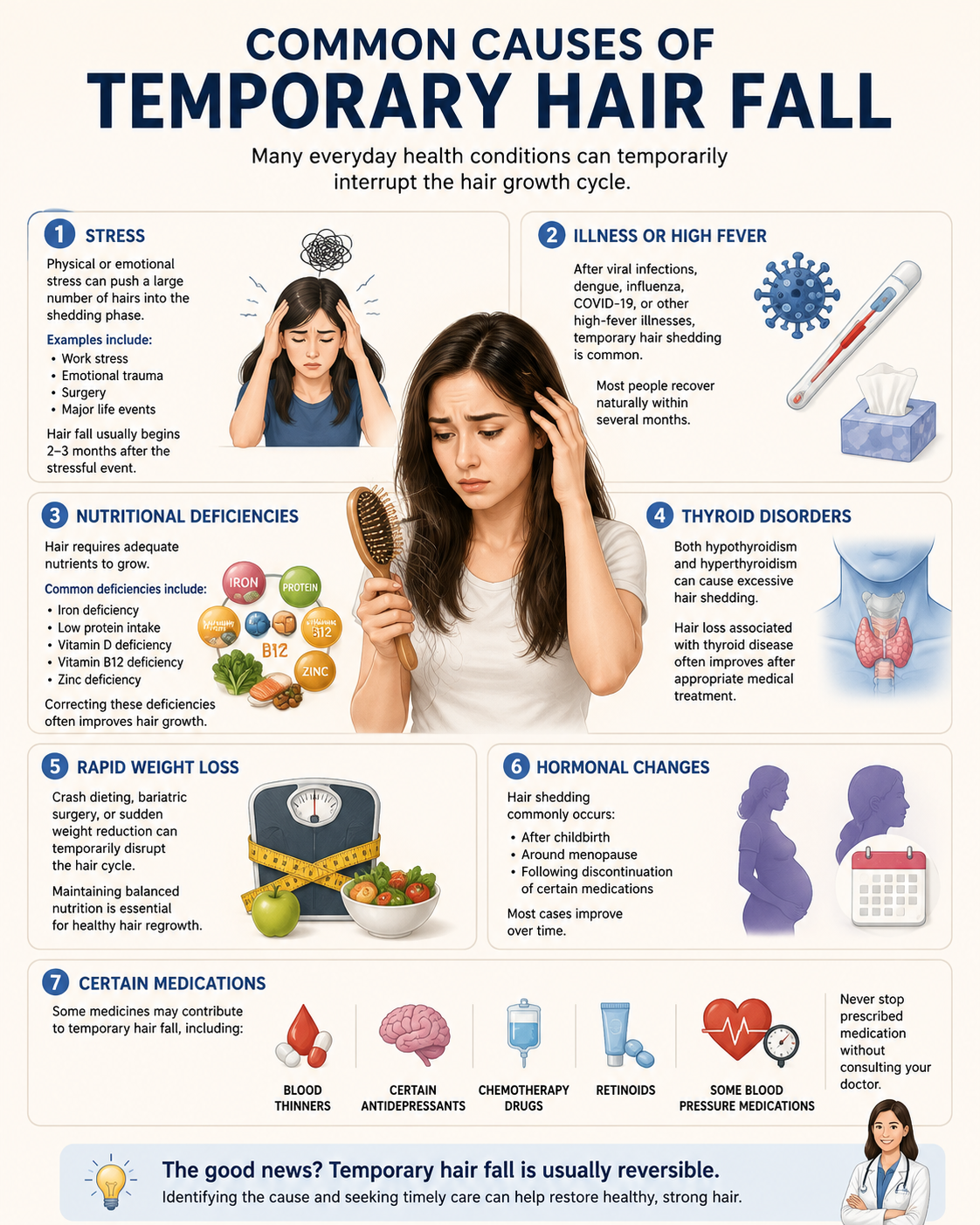
Common Causes of Temporary Hair Fall
Many everyday health conditions can temporarily interrupt the hair growth cycle.
1. Stress
Physical or emotional stress can push a large number of hairs into the shedding phase.
Examples include:
- Work stress
- Emotional trauma
- Surgery
- Major life events
Hair fall usually begins 2–3 months after the stressful event.
2. Illness or High Fever
After viral infections, dengue, influenza, COVID-19, or other high-fever illnesses, temporary hair shedding is common.Most people recover naturally within several months.
3. Nutritional Deficiencies
Hair requires adequate nutrients to grow.
Common deficiencies include:
- Iron deficiency
- Low protein intake
- Vitamin D deficiency
- Vitamin B12 deficiency
- Zinc deficiency
Correcting these deficiencies often improves hair growth.
4. Thyroid Disorders
Both hypothyroidism and hyperthyroidism can cause excessive hair shedding.
Hair loss associated with thyroid disease often improves after appropriate medical treatment.
5. Rapid Weight Loss
Crash dieting, bariatric surgery, or sudden weight reduction can temporarily disrupt the hair cycle.Maintaining balanced nutrition is essential for healthy hair regrowth.
6. Hormonal Changes
Hair shedding commonly occurs:
- After childbirth
- Around menopause
- Following discontinuation of certain medications
Most cases improve over time.
7. Certain Medications
Some medicines may contribute to temporary hair fall, including:
- Blood thinners
- Certain antidepressants
- Chemotherapy drugs
- Retinoids
- Some blood pressure medications
Never stop prescribed medication without consulting your doctor.
Early Signs of Pattern Hair Loss
Recognising early warning signs can help preserve hair before significant loss occurs.
Watch for:
- A slowly receding hairline
- Increased visibility of the scalp
- Thinning at the crown
- Wider hair part in women
- Hair becoming finer or shorter
- Family history of baldness
- Reduced hair density over time
These changes usually occur gradually rather than suddenly.
Common Myths About Hair Fall
Myth 1: Every Hair Fall Means Baldness
Fact: Temporary hair shedding is very common and usually reversible.
Myth 2: Wearing Caps Causes Baldness
Fact: Hats do not cause permanent hair loss.
Myth 3: Frequent Shampooing Causes Hair Loss
Fact: Washing your hair removes hairs that were already in the shedding phase. Shampooing itself does not cause baldness.
Myth 4: Cutting Hair Makes It Grow Thicker
Fact: Haircuts affect only the visible hair shaft, not the hair follicle.
Myth 5: Hair Oils Can Cure Genetic Baldness
Fact: Oils may improve hair conditioning and scalp health but cannot reverse hereditary pattern baldness.
When Should You See a Dermatologist?
Seek professional evaluation if you notice:
- Hair loss lasting more than three months
- Rapid thinning of the scalp
- A receding hairline
- Bald patches
- Excessive daily hair shedding
- Scalp itching, redness, or scaling
- Hair loss after illness that does not improve
- A strong family history of baldness
A dermatologist can identify the underlying cause through a detailed examination and, if necessary, blood tests or scalp evaluation.
Early diagnosis often leads to better treatment outcomes.
Can Temporary Hair Loss Be Treated?
Yes. The treatment depends on the underlying cause.
Management may include:
- Correcting nutritional deficiencies
- Treating thyroid disorders
- Managing stress
- Improving dietary protein intake
- Addressing scalp conditions
- Medical therapies when appropriate
Most patients with temporary hair fall experience gradual regrowth once the trigger is resolved.
Final Thoughts
Hair fall does not always mean you are going bald. Temporary hair shedding is common and often reversible, while pattern baldness develops gradually and benefits from early treatment.
If you are unsure whether your hair loss is temporary or permanent, don’t rely on internet myths or home remedies alone. A dermatologist can determine the cause and recommend the most appropriate treatment plan before significant hair loss occurs.
Early action can make a meaningful difference in preserving healthy hair.