24th August 2026
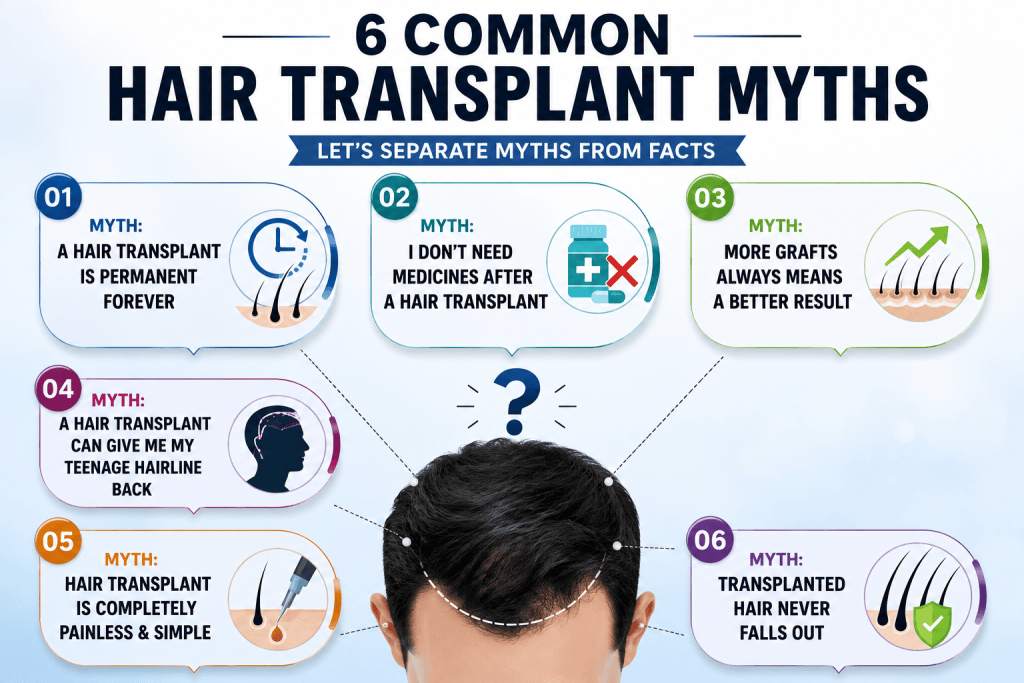
Thinking about a hair transplant? Before you decide, make sure you know what is fact and what is fiction. From “transplanted hair never falls” to “more grafts always mean better results,” let's uncover the truth behind the most common hair transplant myths.
Hair transplantation has become one of the most popular solutions for hair loss. With modern techniques such as FUE and FUT, results can look remarkably natural—but there is still a lot of misinformation surrounding the procedure.
Patients often come across promises like “one surgery and you're done forever,” “more grafts mean better density,” or “transplanted hair can never fall.”
The reality is more nuanced. A successful hair transplant is not simply about moving hair from one area of the scalp to another. It is about understanding the cause and pattern of hair loss, planning the donor area carefully, designing a natural hairline, using grafts efficiently, and managing the hair that remains. So, before you decide on a procedure, let's separate some of the most common hair transplant myths from the truth.
Myth 1 : “A Hair Transplant Is Permanent Forever”
The truth:
Transplanted hair is generally long-lasting, but your overall hair loss can continue. One of the biggest misconceptions is that a hair transplant permanently stops hair loss. A transplant moves hair follicles—usually from a relatively resistant donor area—to areas affected by hair loss. These transplanted follicles are generally more resistant to androgenetic hair loss. However, the original, non-transplanted hair around them can continue to thin. This means someone may have a successful transplant but still experience progressive thinning of their native hair over the years.
What does this mean for you?
A good transplant plan considers not just today's hair loss, but also the possibility of future progression. That is why age, family history, hair-loss pattern, donor density, and future hair-loss risk should all be considered before surgery.
A transplant can provide long-lasting results, but it does not freeze your entire scalp in time.
Myth 2: “I Don't Need Medicines After a Hair Transplant”
The truth:
Surgery moves hair; it does not necessarily stop the underlying hair-loss process. This is one of the most important things patients should understand. A hair transplant can restore hair in areas where follicles have been lost or significantly reduced. But if you have ongoing pattern hair loss, your existing native hair may continue to miniaturise. Depending on the individual's diagnosis and medical suitability, a dermatologist may recommend medical treatment to help maintain existing hair and manage ongoing hair loss. Treatment may include options such as topical or oral medications, but these should be considered only after appropriate medical evaluation. A transplant should therefore be viewed as one part of a long-term hair-loss management plan, rather than a replacement for medical treatment.
Don't assume surgery means you can forget about hair-loss management forever.
Myth 3: “More Grafts Always Mean A Better Result”
The truth:
More grafts do not automatically mean better hair.
It is easy to think:
More grafts = more hair = better result.
But hair transplantation is not simply a numbers game. Your donor area contains a finite supply of follicles. Using too many grafts unnecessarily can reduce the donor reserve available for future procedures. An experienced surgeon considers:
Donor hair density, hair calibre, graft quality, number of hairs per graft, recipient-area size, existing native hairline design, future hair-loss pattern, age, and long-term expectations
The goal is not to use the maximum number of grafts. The goal is to use the right number of grafts in the right places.
Good transplantation is about strategic graft distribution—not simply a high graft count.
Myth 4: “A Hair Transplant Can Give Me My Teenage Hairline Back”
The truth:
A natural adult hairline is usually more important than an extremely low hairline. Many people understandably want the hairline they had at 16 or 18. But recreating an aggressively low teenage hairline may not always be a sensible long-term strategy. Why? Because hair loss can continue. If a very low hairline is created using a large number of grafts and the hair behind it continues to recede, the result may become unnatural and difficult to manage. A well-planned hairline generally takes into account:
Your age + facial proportions + existing hair loss + donor supply + future progression.
The best hairline is not necessarily the lowest hairline. It is the one that looks natural today and remains appropriate as you age.
A good hair transplant should make people notice your hair—not your hairline design.
Myth 5: “Hair Transplant Is Completely Painless and Very Simple”
The truth:
Modern transplantation can be performed comfortably, but it is still a surgical procedure. Techniques have improved significantly, and local anaesthesia can make the procedure comfortable for most patients. However, that doesn't mean there is zero discomfort.
Patients may experience Mild discomfort during anaesthesia; tightness or swelling, scalp tenderness, temporary redness, crusting, and itching during healing.
Post-operative discomfort: Recovery also varies from person to person. Calling a transplant “completely painless and effortless” can create unrealistic expectations.
Hair transplantation can be well tolerated, but it should still be treated as a medical procedure requiring proper planning and aftercare.
Myth 6: “All Hair Transplant Clinics Give the Same Results”
The truth:
The technique matters—but the planning, expertise and execution matter just as much. Two clinics may both advertise FUE, yet their results can be very different. Why? Because the final outcome depends on multiple factors, including:
Proper patient selection, Diagnosis of the cause of hair loss,
Hairline planning, Graft harvesting, graft handling, recipient-site design, graft placement, density planning, donor-area preservation, post-operative care.
A clinic's marketing material or the name of a technique should not be the only basis for choosing where to undergo surgery. Instead, patients should look for qualified medical professionals, transparent consultation, realistic expectations, appropriate planning, and genuine before-and-after results.
The procedure may have the same name, but the planning and execution can make a major difference.
Myth 7: “Transplanted Hair Never Falls Out”
The truth:
Transplanted hair can shed temporarily—and this does not necessarily mean the transplant has failed. After transplantation, the newly implanted hairs may go through a temporary shedding phase. This is commonly known as shock loss or postoperative shedding, depending on what is happening. The important point is that the visible hair shaft can shed while the follicle remains present beneath the skin. Hair growth then occurs gradually as the follicle moves through its normal growth cycle. This is one reason patients should not judge their final result too early. Hair growth is a biological process, not an overnight transformation.
Temporary shedding after a transplant can be part of the normal recovery and growth process.

The Biggest Hair Transplant Myth of All?
“A Hair Transplant Is Just About Getting More Hair.”
It isn't. A successful hair transplant is about creating a natural-looking result while protecting your future hair options. That means thinking beyond the immediate transformation. A good treatment plan asks: Where are you losing hair today? Where could you lose hair tomorrow? How much donor hair do you actually have? How should the grafts be distributed? What hairline will still look natural years from now? These questions are often more important than simply asking,
“How many grafts will I get?”
What Should You Ask Before Getting a Hair Transplant?
Before making a decision, consider asking your doctor:
1. What is causing my hair loss?
Not every type of hair loss requires a transplant.
2. Am I a suitable candidate?
Donor supply, hair-loss pattern, age and scalp condition all matter.
3. How much hair loss might I have in the future?
A transplant should ideally be planned with the future in mind.
4. How many grafts do I actually need?
The answer should be based on your individual scalp—not simply a package or number.
5. What happens to my existing hair?
Ask how your native hair will be protected and managed.
6. What should I realistically expect?
Good medical advice includes limitations as well as potential benefits.
Final Takeaway
Hair transplantation can be an excellent option for appropriately selected patients, but it is not a magic reset button for hair loss.
The best results come from realistic expectations, careful diagnosis, thoughtful planning and long-term management. So, when you hear:
“It's permanent forever."
”You won't need medicines.”
"More grafts always mean better results.”
“We can give you your teenage hairline.”
“It's completely painless.”
“Every clinic gives the same result.”
“Transplanted hair can never fall."
”Pause and ask one simple question"
“What is the medical reality behind that promise?”
Because when it comes to hair transplantation, understanding the truth before surgery is just as important as choosing the procedure itself.