15th September 2026
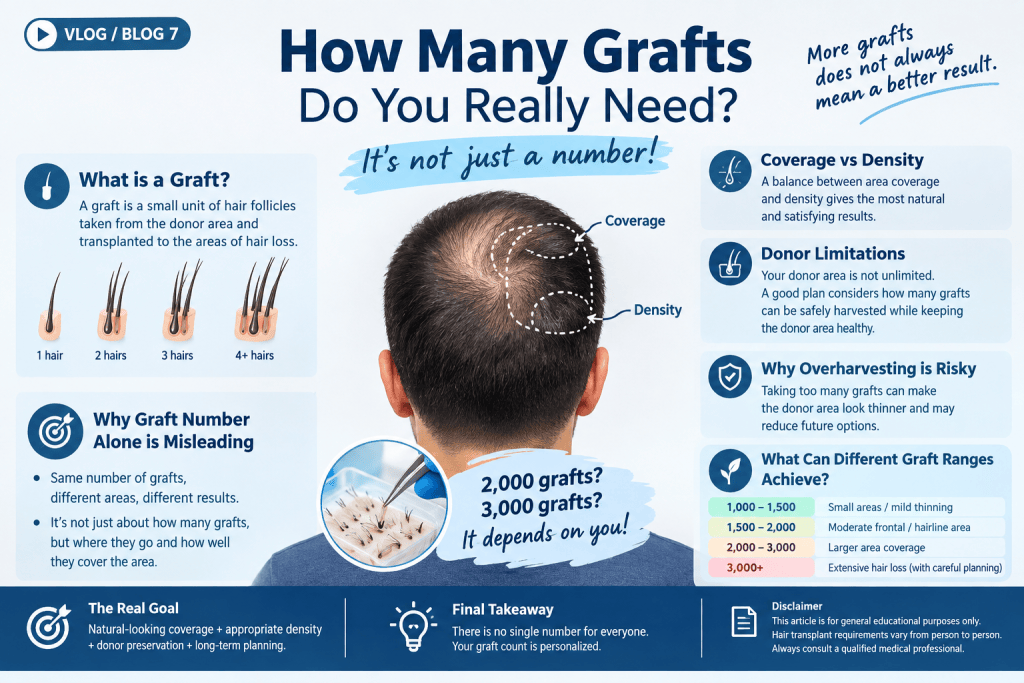
This is one of the most common questions patients ask. You may have seen numbers like 1,500, 2,000, 3,000, or even 4,000 grafts. But the truth is simple:More grafts do not automatically mean a better result. The right graft number depends on your hair loss, the area that needs coverage, your donor hair, and your long-term goals.
What Is a Hair Graft?
A graft is a small unit of hair follicles taken from the donor area and transplanted to areas affected by hair loss. One graft may contain one, two, three, or sometimes more hair follicles. That means 2,000 grafts does not simply mean 2,000 hairs. The number of hairs and the number of grafts are two different things.
Why Graft Number Alone Can Be Misleading
Imagine two people both getting 2,000 grafts . One may have a smaller thinning area and achieve good coverage.The other may have a larger area of hair loss and may need to spread the same number of grafts over a wider region.So, the important question is not just:
“How many grafts?”It is:“Where are the grafts going, and how effectively will they cover the area?”
Coverage vs Density
Hair transplant planning involves balancing coverage and density. If a large area needs coverage, the available grafts may need to be distributed strategically. A smaller area may allow higher density, while a larger area may require broader coverage with lower density. The goal is to create a result that looks natural and works well with the available donor hair. Is 2,000 Grafts Enough? A 2000 graft hair transplant can be suitable for some patients, but it may not be enough for everyone. For one person, 2,000 grafts may improve the hairline and frontal area. For another, the same number may need to cover a much larger area. This is why graft calculation should be based on individual assessment rather than a fixed number.
Donor Hair Has Limits
Your donor area is not an unlimited source of hair.A good hair transplant plan considers how many grafts can be safely harvested while maintaining the appearance and strength of the donor area.This becomes especially important when planning treatment for progressive hair loss.
Why Overharvesting Is Risky
Taking too many grafts from the donor area can make it look visibly thinner and may reduce the options available for future treatment. That is why a good treatment plan should think beyond the first procedure.
Donor preservation today can protect your options for tomorrow.
What Can Different Graft Ranges Achieve?
Every patient is different, but graft ranges can give a general idea:
1,000–1,500 grafts
May be considered for smaller areas such as a mild hairline change or limited thinning.1,500–2,000 grafts
May provide improvement to a moderate frontal or hairline area, depending on the individual pattern.2,000–3,000 grafts
May be used when a larger area requires more coverage.3,000+ grafts
May be considered for more extensive hair loss, but the donor area, safety, and long-term strategy become even more important. These numbers are not a formula. The actual graft requirement must be calculated for each individual.
The Real Goal Is Not “More Grafts” The goal of a hair transplant should be: Natural-looking coverage + appropriate density + donor preservation + long-term planning.
A successful result is not about chasing the biggest graft number. It is about using the right number of grafts in the right way.
Final Takeaway
So, how many grafts are needed?
There is no single number that works for everyone. Your required graft count depends on factors such as:·
The pattern and extent of hair loss· Size of the area requiring coverage· Existing hair density· Donor hair availability· Desired density· Future hair-loss pattern· Long-term donor preservation . The smartest hair transplant plan is not:
“How many grafts can we take?” It is:
“How many grafts do you actually need — while protecting your donor area for the future?”