9th September 2026
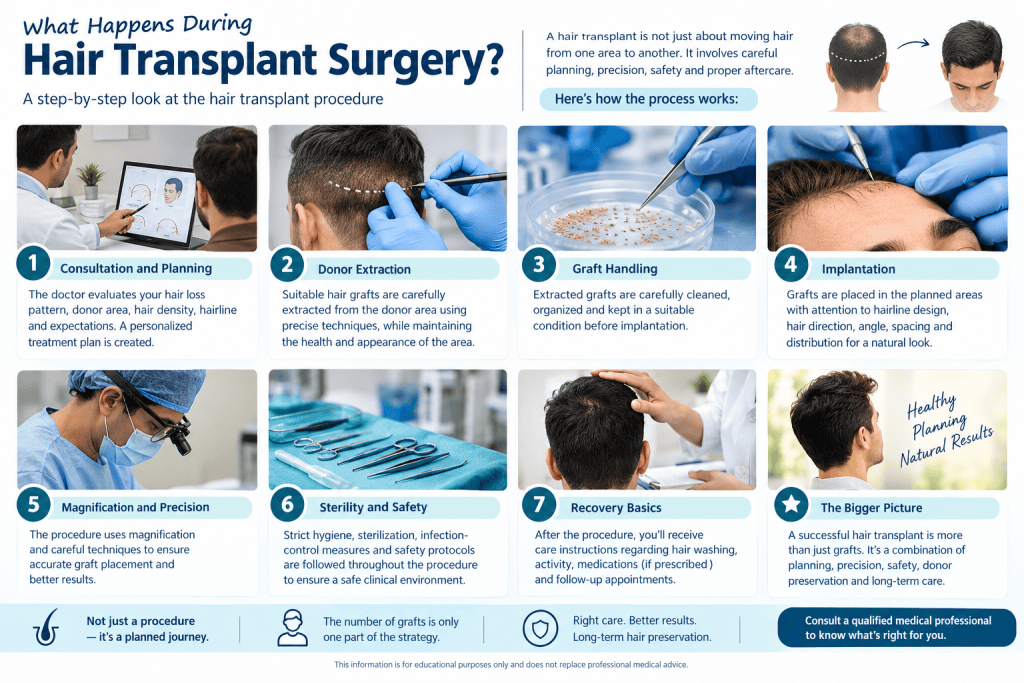
1. Consultation & Planning
The process begins with understanding the cause and pattern of hair loss.Your doctor evaluates your hairline, scalp, donor area, hair quality, existing hair and future hair-loss pattern. This helps determine whether a transplant is suitable and how the available donor hair can be used responsibly.
2. Hairline & Donor Area Assessment
A natural-looking hairline should match your facial features, age and existing hair pattern.The donor area, usually at the back and sides of the scalp, is also carefully assessed. Since donor hair is limited, preserving it for the future is an important part of treatment planning.
3. Graft Extraction
Depending on the patient's condition and treatment plan, we may consider techniques such as FUE or FUT.
FUE: Individual follicular units are extracted from the donor area.
FUT: A strip of hair-bearing scalp is removed and divided into individual follicular units. The appropriate technique depends on the individual patient rather than simply choosing the most popular method.
4. Graft Preparation & Handling
After extraction, the grafts are carefully prepared and handled before implantation.Proper graft handling is important because the follicles need to remain protected throughout the procedure.
5. Implantation
The prepared grafts are placed into the recipient area according to the planned hairline, direction, angle and density.The goal is not simply to add as many grafts as possible. The objective is to create a natural appearance while using the donor supply wisely.
6. Safety & Precision
Hair transplantation is a surgical procedure, so hygiene, sterilisation, appropriate anaesthesia, and patient monitoring are important. Magnification and careful handling can also help the surgical team work with small follicular units more precisely.
7. Recovery
After the procedure, you will receive instructions about scalp care, washing, medications and activities to avoid during recovery. Some transplanted hair may shed during the early weeks. This does not necessarily mean that the procedure has failed. New hair growth takes time.
8. When Will You See Results?
Hair growth is gradual. Visible improvement usually takes several months, and the final outcome may take around 9–12 months or longer, depending on the individual.It is important not to judge the result too early.
9. Can Hair Loss Continue After a Transplant?
Yes.
A transplant does not necessarily stop hair loss in your existing, non-transplanted hair. For some patients, medical treatment and long-term monitoring may be recommended to help maintain the overall result.The Most Important Point: A successful hair transplant is not about getting the maximum number of grafts. It is about: Right diagnosis → Good planning → Donor preservation → Careful graft handling → Natural implantation → Proper aftercare. Every patient is different. The best treatment plan is one that provides a natural-looking result while protecting your donor hair for the future. If you are considering a hair transplant, consult a qualified dermatologist or hair-restoration surgeon for an individualised assessment.