29th August 2026

A natural-looking hair transplant is not simply about adding more hair. One of the most important parts of a successful hair transplant is designing a hairline that looks appropriate for the person's face, age, hair characteristics and long-term hair-loss pattern.A hairline that looks good immediately after a procedure should also look natural years later.
1. Hairline Design Is About More Than Drawing a Line
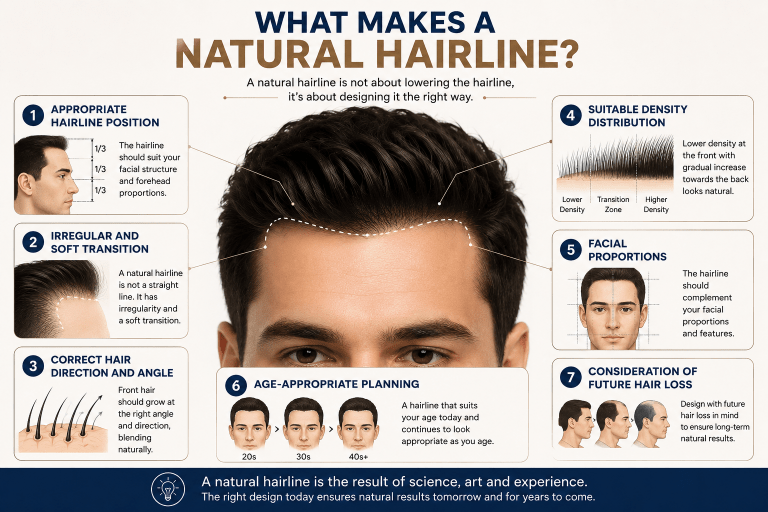
A natural hairline is rarely a perfectly straight line. During hair transplant planning, several factors are considered, including the shape of the forehead, facial proportions, existing hairline pattern, hair density and calibre, direction and angle of hair growth, and current and potential future hair loss. The goal is to create an irregular, soft transition rather than an obvious straight boundary between the forehead and transplanted hair.
2. Facial Proportions Matter
Every face is different. A hairline that looks natural on one person may look unusual on another. The design should therefore take into account the forehead height, facial width, facial shape and overall proportions. This is one reason why copying another person's hairline is usually not the best approach. The hairline should complement the individual's own facial features.
3. An Age-Appropriate Hairline Looks More Natural
One common misconception is that the best hair transplant hairline is the lowest possible hairline. In reality, an excessively low hairline may look artificial, particularly as a person gets older. A well-planned hairline should consider current age as well as future hair loss. The objective is to create a design that remains aesthetically appropriate over the long term—not just immediately after surgery.
4. Density Should Be Distributed Carefully
A natural-looking result does not necessarily require the same density everywhere. The frontal hairline often needs a softer transition, while density can gradually increase behind it. The surgeon may plan graft placement according to:
Hairline → Transition zone → Frontal region → Mid-scalp
This distribution helps create a more natural visual appearance
5. Why an Aggressively Low Hairline Can Look Artificial
Trying to recreate a teenage hairline by placing the hairline extremely low can create several problems. It may look unnatural, make the forehead appear unusually small, require a large number of grafts, leave fewer donor grafts available for future hair loss, and become more noticeable if native hair continues to thin. This is why long-term planning is an important part of hair transplant design.
6. Ethnic and Individual Characteristics Matter
Hair characteristics differ between individuals and populations. Factors such as: Hair textureHair thicknessCurl or wave pattern, skin-to-hair contrast, and facial structure can influence how a hairline should be designed. There is therefore no universal hairline template that works for everyone.
7. Long-Term Planning Is Essential
Hair transplantation should be considered as a long-term process rather than simply a one-time cosmetic procedure. Before designing the hairline, it is important to consider:
Current hair loss + future hair loss + donor hair availability + age + facial proportions
A conservative, well-planned hairline may provide a more natural result over time than an aggressive design focused only on immediate appearance.What Makes a Hair Transplant Look Natural? The best results are usually not about making it obvious that someone had a hair transplant. Instead, the goal is for the transplanted hair to blend naturally with the person's existing hair and facial features.
Final Takeaway
A natural hair transplant hairline is the result of careful planning—not simply placing as many grafts as possible. The right design considers facial proportions, age, hair characteristics, density, donor availability and future hair loss. When these factors are planned together, the result can look much more natural and remain aesthetically appropriate for years to come.
Natural-looking hair transplantation starts with a hairline designed for the individual—not a one-size-fits-all template.