3rd June 2026
Thinking about a hair transplant? Learn how the procedure works, who is a suitable candidate, recovery timeline, costs, myths, and realistic expectations.
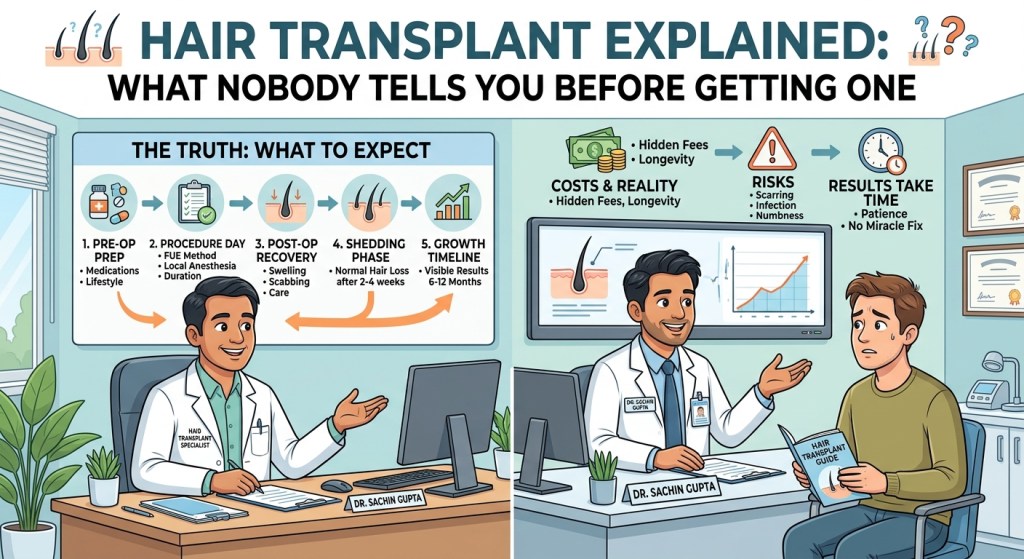
If you’ve been noticing more hair on your pillow, in the shower drain, or seeing your hairline slowly move backwards every year, you’re definitely not alone.
Hair loss affects millions of men and women, and for many people it becomes much more than just a cosmetic concern. It can impact confidence, social interactions, photographs, and sometimes even the way people see themselves.
Naturally, when hair loss starts becoming more visible, most people begin searching for solutions. Somewhere during that search, they come across one treatment that promises permanent results: a hair transplant.
But before you book a procedure, it’s important to understand what a hair transplant can realistically achieve—and what it cannot.
What Is a Hair Transplant and How Does It Work?
A hair transplant is a procedure where healthy hair follicles are taken from one part of your scalp and moved to areas where hair has become thin or completely absent.
The back and sides of the head are usually chosen as donor areas because the hair in these regions is genetically stronger and less likely to fall out due to male pattern baldness.
Once transplanted, these follicles continue growing hair in their new location, helping improve hair density and restore a more natural-looking hairline.
Sounds simple, right?
While the concept is straightforward, achieving natural-looking results requires careful planning, proper technique, and realistic expectations.
Why Are More People Choosing Hair Transplants Today?
A decade ago, hair transplants were often associated with unnatural-looking “pluggy” results that were easy to spot.
Today, modern techniques have changed that perception dramatically.
Advancements in hair restoration allow surgeons to place individual hair follicles with precision, creating results that can look remarkably natural when performed correctly.
Another reason for the growing popularity is social media. Celebrities, athletes, influencers, and public figures openly discuss their hair restoration journeys, making the procedure more mainstream than ever before.
However, social media also creates a problem.
Many videos show dramatic “before and after” transformations without explaining the months of recovery, the importance of donor hair quality, or the fact that not everyone is an ideal candidate.
The Biggest Misunderstanding About Hair Transplants
One of the most common myths is that a hair transplant instantly gives you a full head of hair.
In reality, that’s not how the process works.
After the procedure, many transplanted hairs actually shed within the first few weeks. This often surprises patients who expect immediate growth.
The good news is that the hair follicles remain alive beneath the skin.
Over the following months, new hair gradually begins to grow.
Most patients notice visible improvement between three and six months, while the final result often takes twelve months or longer.
Hair restoration is a journey, not an overnight transformation.
Are You a Good Candidate for a Hair Transplant?
This is probably the most important question.
Not everyone experiencing hair loss should undergo a hair transplant immediately.
A successful transplant depends heavily on the availability of healthy donor hair. If the donor area is weak, the results may be limited regardless of the technique used.
Generally, good candidates are people who:
- Have stable hair loss.
- Possess sufficient donor hair.
- Are in good overall health.
- Have realistic expectations about the outcome.
A proper consultation helps determine whether surgery is the right option or whether non-surgical treatments should be considered first.
What Results Can You Realistically Expect?
A hair transplant can improve hair density and create the appearance of fuller hair.
However, it is important to understand that the procedure does not magically restore the hair density you had at age eighteen.
The goal is natural-looking improvement rather than perfection.
The best outcomes occur when patients understand what is achievable and work with experienced professionals who prioritize natural results over unrealistic promises.
Final Thoughts
Hair loss can be frustrating, emotional, and sometimes overwhelming. With so much information available online, it’s easy to become confused about what actually works.
A hair transplant can be an effective long-term solution for suitable candidates, but success begins with education and realistic expectations.
If you’re considering a hair transplant, spend time understanding the procedure, ask questions during consultations, and focus on finding accurate information rather than marketing claims.
The more informed you are, the better your decisions will be—and that’s ultimately the first step toward any successful hair restoration journey.
Author profile reference: Dr Sachin Gupta Consultant Dermatologist MBBS, MD (AIIMS New Delhi) Department of Dermatology